



Performance Data
Performance Information 2025-2026
Woodland Primary Academy is committed to providing an ambitious, inclusive education that enables all pupils to achieve success. Performance information should be viewed alongside the context of the school, including the increasing complexity of pupil needs and the school's specialist SEND provision. Achievement is evaluated through attainment, progress, curriculum engagement, communication, independence and readiness for the next stage of education.
Key Stage 2 Results 2026
The statutory Year 6 cohort consisted of 23 pupils. The cohort presented a highly complex profile, including:
- 50% of pupils identified as SEND
- 62.5% disadvantaged pupils
- 58.3% joining the school after Reception
- 45.8% persistently absent pupils
- High levels of communication, cognition and learning needs, including ASD, MLD, SLCN and SEMH needs.
Attainment at the End of Key Stage 2
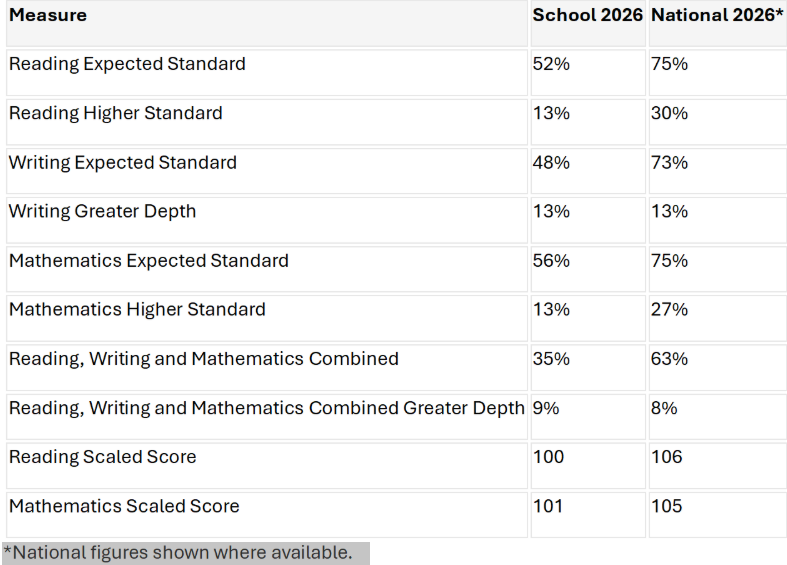
Key Stage 2 Commentary
The 2026 Year 6 cohort contained significantly higher levels of SEND, disadvantage and pupil mobility than are typically found nationally. Whilst attainment outcomes were below national averages, leaders' analysis demonstrates that outcomes were significantly influenced by cohort context. Pupils generally sustained their prior attainment profile throughout Key Stage 2 despite substantial barriers to learning, including persistent absence, complex SEND needs and disruption to early education.
Grammar, Punctuation and Spelling (GPS) remained a relative strength, with 69.6% achieving the expected standard and 21.7% achieving Greater Depth. Mathematics was also the strongest tested subject.
Two pupils (9%) achieved Greater Depth across Reading, Writing and Mathematics combined, slightly above the national figure of 8%. Higher prior attainers performed particularly strongly, with all achieving the expected standard across Reading, Writing, Mathematics and GPS. Several pupils sustained Greater Depth attainment from Key Stage 1 through to Key Stage 2, demonstrating the school's ability to provide effective challenge for its highest-attaining pupils.
Several pupils made strong progress from lower starting points and successfully achieved age-related expectations by the end of Key Stage 2. Analysis also demonstrated that pupils without SEND achieved outcomes considerably closer to national expectations.
Non-SEND Cohort Analysis
To provide additional context regarding the impact of the school's inclusive intake, outcomes for pupils without SEND are shown below.
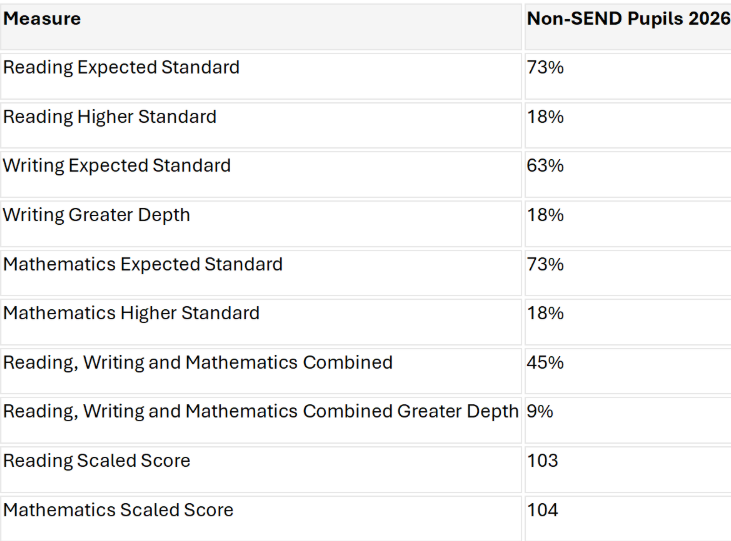
This analysis demonstrates that outcomes for pupils without significant additional needs were considerably stronger than whole-cohort attainment figures suggest. In Reading and Mathematics, 73% of non-SEND pupils achieved the expected standard, with 18% achieving the higher standard in
Reading, Writing and Mathematics. Leaders remain committed to providing highly inclusive provision whilst maintaining high expectations and strong levels of challenge for all pupils.
Year 4 Multiplication Tables Check 2026
Results
Commentary
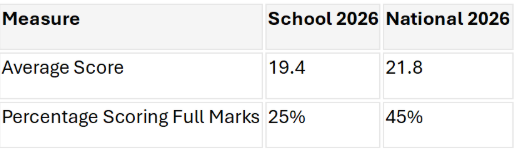
Whilst published outcomes were below national averages, internal assessment demonstrated strong progress throughout Year 4.
- Pupils achieving full marks increased from 17% at baseline to 35%.
- Pupils scoring 20 or above increased from 52% to 70%.
- Pupils scoring below 15 reduced from 30% to 17%.
These outcomes reflect the impact of daily multiplication fluency practice, targeted intervention, regular retrieval activities and ongoing assessment.
Year 1 Phonics Screening Check 2026
Statutory Results

Additional Context
The school includes pupils educated within specialist SEND provision within its statutory outcomes.Within the mainstream Year 1 cohort:
- 94% of pupils achieved the expected standard, compared with 82% nationally.
- Mainstream pupils with SEND achieved a 100% pass rate.
- Disadvantaged pupils attained in line with their peers.
- The average phonics score for the mainstream cohort was 36 marks.
These outcomes demonstrate the strength of the school's early reading provision and the effectiveness of adaptive teaching and targeted support.
Early Years Foundation Stage 2026
Good Level of Development

Commentary
Children entered Reception with varied starting points and a range of additional barriers, including English as an Additional Language (EAL), SEND and in-year admissions.
Achievement in Early Years continues to improve:
- GLD outcomes increased from 58% in 2025 to 67% in 2026.
- When children educated within specialist SEND provision are considered separately, 71% achieved a Good Level of Development.
- Communication and Language outcomes were particularly strong, with 80% of children achieving the expected standard.
- DfE contextual analysis found outcomes were 9.2 percentage points above those predicted for schools with similar levels of disadvantage and SEND.
Children made particularly strong progress in Communication and Language, Personal, Social and Emotional Development and Physical Development. Leaders judge that children leave Reception well prepared for the next stage of their education.
Further Information
Woodland Primary Academy remains committed to ensuring that all pupils, regardless of need or background, receive an ambitious and inclusive education.
Leaders evaluate achievement through a broad range of evidence, including:
- Academic attainment and progress
- Communication and language development
- Independence and personal development
- Curriculum participation and engagement
- Preparation for the next stage of education
- Outcomes for pupils accessing specialist SEND provision
This approach ensures that achievement is understood within the context of pupils' starting points, individual needs and the school's commitment to inclusion.